
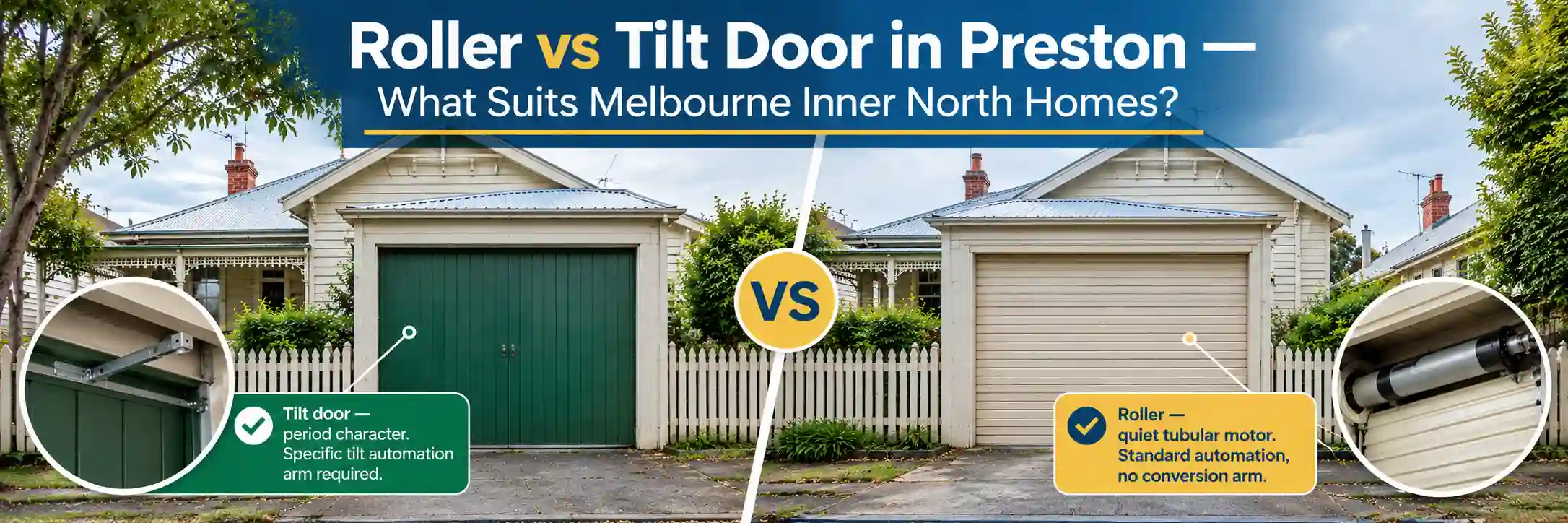
Roller vs tilt door in Preston is a buying decision that is specific to the inner north Melbourne context in a way that the equivalent roller vs sectional comparison in Queensland or NSW is not. In Preston’s established residential streets — the weatherboard cottages, the interwar brick homes, the rear-lane garages, and the period housing that defines the inner north’s character — the tilt door is not simply one option among several but the historically dominant and period-appropriate garage door type.
The tilt door was the standard garage door for Melbourne suburban homes from the post-war period through the 1970s, and Preston’s housing stock — with its concentration of homes from these decades — carries a higher proportion of original or early-replacement tilt doors than any of the newer suburban developments in this guide series. Understanding when a tilt door replacement is the right decision and when a roller door is the more appropriate upgrade is the specific knowledge that Preston homeowners need before any garage door product decision is made.
The tilt door in Preston’s inner north context
Roller vs tilt door in Preston — understanding the tilt door’s specific position in the inner north:
- The period-appropriate choice for weatherboard homes — the tilt door is the garage door type that was installed on Melbourne’s weatherboard and brick homes from the 1950s through the 1970s. A weatherboard home in Preston that still has its original tilt door, or a tilt door replacement from the 1980s, has a garage door whose proportions, single-panel format, and character relate to the home’s era in a way that a roller curtain or sectional panel does not. For Heritage Overlay properties in Preston, a tilt door replacement is the most straightforward heritage-compatible option for a failed tilt door system.
- The single-panel tilt format — a tilt door operates as a single panel that pivots at the mid-point, swinging outward at the base and upward to a horizontal position above the opening as it opens. This single-panel format gives the closed tilt door a clean, simple appearance that is appropriate for the streetscapes of Preston’s period residential streets.
- Space clearance requirements — the tilt door requires clearance in front of the opening — the bottom of the door swings outward by approximately 300 to 400 millimetres before traveling upward. For Preston garages where the driveway approach is short between the garage opening and the street, the tilt door’s required front clearance must be confirmed before a replacement tilt door is ordered. A driveway that is shorter than the required front clearance makes a tilt door impractical regardless of its heritage character advantages.
- Spring system limitations — the tilt door’s counterbalance spring system — typically a pair of side-mounted extension springs — has a finite service life. For Preston’s original tilt doors from the 1950s through 1970s, the spring systems are between 50 and 70 years old and are well past their designed service lives. The spring failure that generates most of the tilt door repair calls in Preston is the predictable outcome of a spring that has been in service for decades in Melbourne’s cold wet winters without appropriate maintenance.
When to choose a tilt door in Preston
Roller vs tilt door in Preston — the tilt door is the correct choice when:
- The property is in a Heritage Overlay precinct and the heritage assessment supports or requires a tilt door in a character-compatible material and colour.
- The existing garage door is a tilt door and a like-for-like replacement is the appropriate maintenance response.
- The garage opening dimensions and the available front clearance accommodate the tilt door’s swing-out requirement.
- The homeowner values the period character of a tilt door on a weatherboard or interwar brick home and is willing to maintain the timber or steel panel of the tilt door appropriately for Melbourne’s seasonal conditions.
- The garage is not automated, or the homeowner is prepared to install a specific tilt door conversion arm to automate the tilt door — which requires a different automation setup than a roller or sectional door.
When to choose a roller door in Preston
Roller vs tilt door in Preston — the roller door is the more appropriate choice when:
- The available front clearance is insufficient for a tilt door’s swing-out — for example, a rear-lane garage where the lane width limits the vehicle approach and any outward swing in front of the opening would block the lane.
- The garage ceiling height is adequate for a roller door drum above the opening but the tilt door’s track system requires more internal garage depth than is available.
- The homeowner’s priority is automation reliability and quiet operation rather than period character — a tubular motor inside the roller door drum is the quietest available automation option in Melbourne, including for Preston’s attached garages adjacent to living areas.
- The property is not in a Heritage Overlay and the homeowner’s preference is for contemporary functionality over period character.
- The existing tilt door frame or structure has deteriorated to the point where a full system replacement is required, and the roller door’s simpler mechanism and longer service life between services is the more economical long-term choice.
The automation question — tilt door vs roller in Preston
Roller vs tilt door in Preston for automated operation: the automation approach differs significantly between the two types. A roller door is automated by a motor inside the drum (tubular motor) or by a ceiling-mounted motor driving the door via a rail — both well-established systems with a wide range of available products. A tilt door is automated by a ceiling-mounted motor connected to the door via a tilt door conversion arm — a specific mechanism that accommodates the tilt door’s pivot-and-swing travel path rather than the straight vertical travel of a roller door. Not all standard residential garage door motors are compatible with tilt door automation, and a tilt door automation installation requires either a specific tilt door motor or a compatible conversion arm mechanism.
For Preston homeowners with a non-automated tilt door who want to add automation, the choice between automating the existing tilt door with a compatible motor and conversion arm, or replacing the tilt door with a roller door and installing a standard tubular motor, is a genuine decision point. The tilt door automation is the character-preserving choice; the roller door with tubular motor is the simpler, quieter, and potentially more reliable automation choice for long-term daily use.
Heritage Overlay and the roller vs tilt decision in Preston
Roller vs tilt door in Preston for Heritage Overlay properties: the Heritage Overlay assessment framework has specific implications for the roller vs tilt decision. A tilt door replacement in the same material and colour as the existing door is typically the lowest-risk heritage outcome — like-for-like replacements are generally exempt from permit requirements.
A change from a tilt door to a roller door is a change of door type that is assessable under the Heritage Overlay, even if the roller door is in a heritage-appropriate colour. For Heritage Overlay properties where the existing tilt door has failed, a pre-application consultation with City of Darebin’s heritage advisor before committing to a roller door replacement is the step that confirms whether the proposed change requires a planning permit and what the heritage assessment is likely to require.
The tilt door’s cultural and historical significance in Melbourne’s inner north should not be underestimated in the roller vs tilt discussion for Preston. The tilt door is not simply a functional mechanism — it is the garage door of the inner north Melbourne era, a material artefact of the period when suburban Melbourne’s working families first had the family car and built the garage addition to house it.
For a Preston homeowner who is restoring a 1950s weatherboard home to its period character, the tilt door in timber or steel is an element of that period character alongside the original floorboards, the pressed metal ceilings, and the timber verandah detailing. A roller door, however practical and however quiet its tubular motor, is not the character of the inner north’s period housing. For Heritage Overlay properties where the period character of the home is actively being protected, the tilt door is not simply the planning-required option — it is the correct expression of the home’s architectural identity.
Conclusion
Roller vs tilt door in Preston is a decision that requires understanding both the heritage character of Preston’s inner north Melbourne housing stock and the specific physical constraints of the property’s garage configuration. The tilt door is the period-appropriate, heritage-compatible choice for Preston’s weatherboard and interwar homes in Heritage Overlay precincts, provided the front clearance and opening dimensions accommodate it. The roller door is the practical choice for constrained rear-lane configurations, short front clearances, and properties where the priority is automated reliability over period character.
For Heritage Overlay properties, a pre-application consultation with City of Darebin’s heritage advisor before any product is ordered is the step that ensures the decision aligns with the heritage assessment framework and avoids the cost and delay of a non-compliant installation.